
In the flap disc manufacturing process, glue plays a critical role. Although the amount of glue used in each disc is small, its quality and performance directly affect the safety, durability, and grinding efficiency of the final product. Choosing the right glue and applying it correctly is essential for every flap disc machine user.
1. Why Glue Is Essential in Flap Disc Manufacturing
- Bonding Abrasive Cloth to the Backing Plate The primary function of glue is to securely attach the abrasive flaps to the backing plate. A reliable bond ensures the flaps will not detach during high-speed grinding. Common backing plate types include:
- Fiberglass backing plate – lightweight, strong, and widely used;
- Plastic backing plate – more economical, used in light-duty applications;
- Metal backing plate – high strength, suitable for heavy grinding;
- Resin-based plate – with flexibility and wear resistance for special uses.
- Enhancing Overall Strength The glue layer provides structural integrity between the flaps and the plate, preventing delamination or detachment during long-term use.
- Heat and Wear Resistance During grinding, friction generates significant heat. High-quality glue must have excellent heat resistance, ensuring the flap disc performs safely and consistently.
2. Does Glue Provide Elasticity During Grinding?
Some customers wonder whether glue provides a cushioning or elastic effect during grinding.
- Technically, glue is primarily a bonding agent, not an elastic material.
- Once cured, the glue may retain some toughness and provide minimal cushioning, but it does not serve as the main source of flexibility.
- In actual grinding, elasticity comes from:
- The abrasive cloth flexibility,
- The backing plate material,
- And the arrangement of abrasive flaps.
Therefore, the main role of glue is strong bonding and heat resistance, not elasticity.
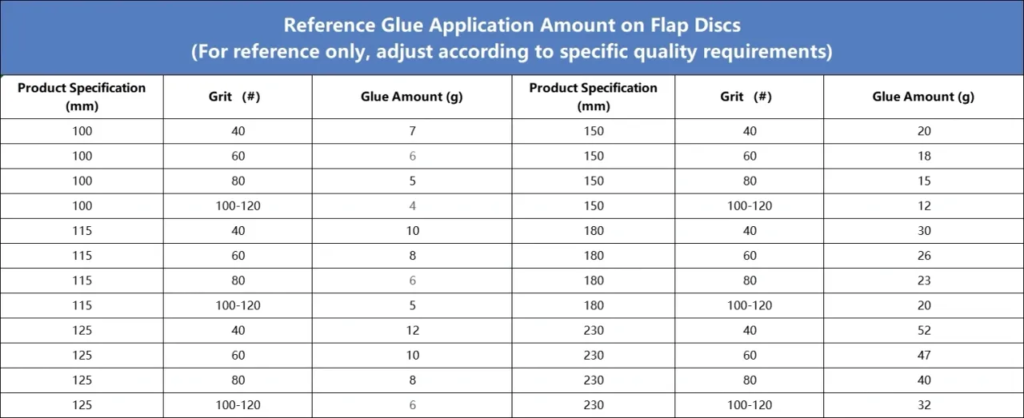
3. Reference Glue Consumption
Different flap disc sizes and abrasive grits require different glue amounts. Below is a general reference (actual production should be adjusted according to product quality requirements):
- 100mm flap disc with 40 grit: approx. 7g glue
- 125mm flap disc with 60 grit: approx. 10g glue
- 150mm flap disc with 80 grit: approx. 15g glue
- 180mm flap disc with 40 grit: approx. 20g glue
- 230mm flap disc with 60 grit: approx. 47g glue
(More detailed charts can be provided based on your production needs.)
4. Conclusion
Although glue may seem like a minor part of the flap disc production line, it is one of the key factors that determine product safety, stability, and efficiency. Using the right glue with proper application not only extends the service life of flap discs but also ensures consistent grinding performance with minimal risks.
👉 If you are considering starting a flap disc production line or have questions about flap disc machines, glue usage, or other production processes, feel free to contact us. Our experienced engineering team has over 12 years of expertise in flap disc equipment and will provide professional technical support tailored to your needs.