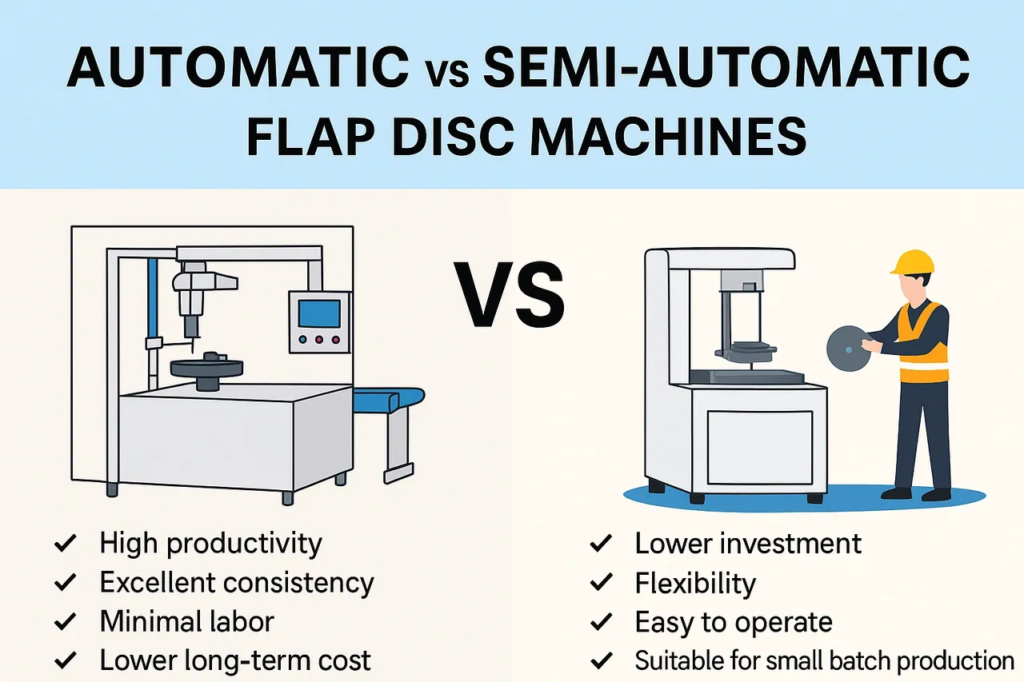
Automatic vs Semi-Automatic Flap Disc Machines: Which One Should You Choose?
In the abrasives industry, flap discs are among the most widely used products. They play a critical role in metal grinding, weld seam processing, and surface finishing. With global demand steadily increasing, more and more manufacturers are investing in flap disc machines to improve productivity and consistency.
A common question arises for many buyers: Should I choose an automatic flap disc machine or a semi-automatic flap disc machine?
This article compares the two machine types in terms of workflow, labor requirements, productivity, investment cost, and market trends — to help you make the right decision.
1. Automatic Flap Disc Machine
Features:
- Handles almost the entire production process automatically: backing placement, glue dispensing, flap cutting and arranging, pressing, and disc removal.
- Operators are mainly responsible for loading raw materials (such as abrasive cloth rolls and backing pads) and transferring finished discs to the curing oven.
Advantages:
- High productivity – ideal for mass production and continuous operation.
- Excellent consistency – every disc has the same angle, glue amount, and flap arrangement.
- Minimal labor – one operator can supervise multiple machines.
- Lower long-term cost – despite higher upfront investment, efficiency reduces overall production costs.
Market trend: Today, most customers prefer to invest in automatic flap disc machines. Rising labor costs and stricter international requirements for product consistency have made automation the mainstream choice.
Best for: Large manufacturers, exporters, or companies with stable long-term orders and strict quality demands.
2. Semi-Automatic Flap Disc Machine
Features:
- Operators need to place the fiberglass backing pad and remove finished discs manually.
- The machine automatically completes glue application, flap cutting, flap arrangement, and pressing.
Advantages:
- Lower investment – more affordable than full automation, ideal for smaller factories.
- Flexibility – suitable for multi-variety, small-batch production.
- Easy to operate – workers can start after basic training.
Limitations:
- Labor dependent – requires more operators.
- Limited efficiency – not suitable for large-scale or urgent orders.
Best for: Small and medium-sized manufacturers, new entrants in the flap disc industry, or factories producing smaller quantities.
3. How to Choose the Right Flap Disc Machine
Before making your investment, consider these questions:
- Production capacity – How many flap discs do you need per month?
- Order type – Do you mainly handle large-scale, long-term orders or small-batch, diversified ones?
- Budget – How much are you willing to invest upfront?
- Labor cost – Are labor costs in your region high?
- Customer requirements – Do your clients demand strict consistency and fast delivery?
If your goal is high-volume, stable production and you have the budget, an automatic flap disc machine is the best choice. If you run a smaller factory with limited budget or produce low-volume, multi-specification orders, a semi-automatic flap disc machine can be more flexible.
4. Conclusion
Both automatic and semi-automatic flap disc machines aim to improve production efficiency and product quality.
- The automatic machine delivers higher efficiency, requires fewer operators, and is now the preferred choice for most customers worldwide.
- The semi-automatic machine offers lower investment and greater flexibility, making it suitable for smaller enterprises.
The right choice depends on your production goals, budget, and customer requirements.